Subterranean moisture dynamics in the East Tennessee foothill topography directly regulate biological pest activity beneath residential foundations. In neighborhoods situated along Melton Hill Lake drainages and the…
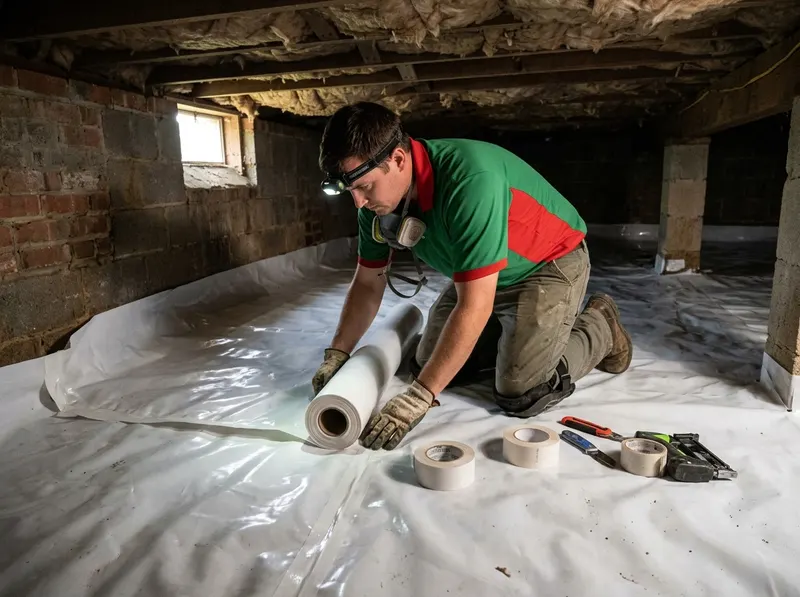
Subterranean moisture dynamics in the East Tennessee foothill topography directly regulate biological pest activity beneath residential foundations. In neighborhoods situated along Melton Hill Lake drainages and the ridges of Haw Ridge Park, such as Rivers Run and Centennial Bluff, soil evaporation rates load unconditioned crawlspaces with excessive ambient relative humidity. During humid summer months between May and September, this damp air condensates on cold ductwork and floor joists. When wood moisture equivalent (WME) levels exceed 18 percent, primary structural pests, notably subterranean termites (Reticulitermes flavipes) and wood-boring beetles, colonize unprotected pine and hardwood framing. Simultaneously, the damp environment harbors populations of camel crickets, silverfish, and American cockroaches, which migrate upward through subfloor plumbing penetrations into living areas.
A clear distinction exists between basic soil vapor barriers and full crawlspace encapsulation. An unsealed 6-mil or 10-mil dirt cover simply slows the ascent of groundwater vapor into the central crawlspace cavity. While sufficient for well-drained properties located on elevated terrain in Highland View or Woodland, it leaves open foundation vents intact. These open vents admit exterior ambient air that routinely hits 80 percent relative humidity during Oak Ridge summers. In contrast, full encapsulation treats the crawlspace as a conditioned interior envelope: 12-mil to 20-mil reinforced polymer is pinned to the foundation walls 3 inches below the sill plate (maintaining a visible termite inspection band), foundation vents are mechanically sealed, piers are wrapped, and a dedicated low-temperature dehumidifier maintains relative humidity below 55 percent. The mechanical trade-off is upfront installation expenditure versus comprehensive protection: soil barriers manage direct ground dampness at a lower entry cost, whereas full encapsulation halts structural decay, reduces indoor radon accumulation, and eliminates subterranean pest habitats completely.
Foundation architecture across Oak Ridge reflects specific mid-century and modern construction traits that dictate encapsulation engineering. In early residential pockets near Jackson Square, Westwood, and Scarboro, concrete block or poured foundations often exhibit narrow access openings and shallow crawl depths under 24 inches, requiring specialized clearance methods before laying membrane. Eastward in Briarcliff, Emory Valley, and Country Club Estates, expansive subfloors frequently house split HVAC systems and multiple foundation pier arrays that necessitate meticulous structural sealing. All encapsulation designs adhere to International Residential Code (IRC) Section R408.3 standards for unvented crawlspaces, preserving the mandatory 3-inch uninsulated perimeter at the top of stem walls so extermination professionals can visually confirm the absence of termite exploratory mud shelter tubes during required annual property evaluations.
Every job gets a firm, written price after a free on-site visit.
Tell us about your crawlspace vapor encapsulation and moisture barrier service job in Oak Ridge and we'll send a clear, written quote, usually the same day.
 Norevia Pest Protection